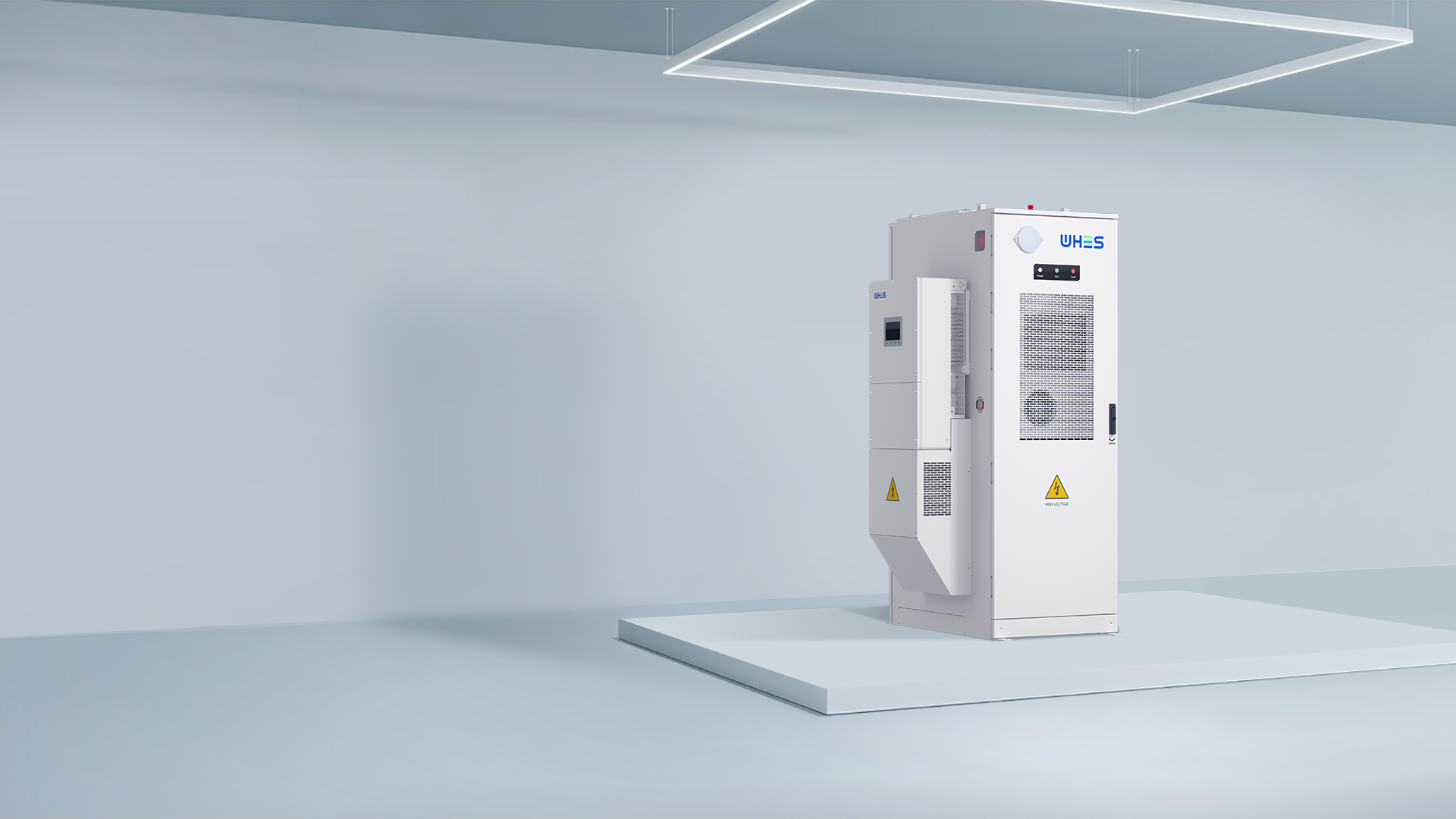
As distributed energy adoption accelerates across commercial and industrial sectors, microgrid energy storage has become a foundational technology for improving energy autonomy and system resilience. By combining generation, storage, and intelligent control, microgrids reduce dependence on centralized grids while optimizing the use of solar battery storage. WHES supports this transition with its PC Mini all-in-one energy storage system, designed to deliver integrated functionality for complex microgrid applications.
Integrated Energy Architecture for Distributed Systems
At the core of microgrid energy storage is the ability to coordinate multiple energy sources within a unified control framework. The WHES PC Mini (29.9–50 kW / 57–100 kWh) integrates PV input, battery storage, and power conversion into a single platform. This all-in-one design reduces system fragmentation and simplifies engineering for EPC contractors and project developers. With support for up to 200% PV oversizing and multi-channel MPPT configuration, the system enhances the efficiency of solar battery storage utilization under variable generation conditions.
Enhancing Energy Independence and Grid Flexibility
A well-designed microgrid energy storage system enables facilities to operate independently from the main grid when necessary. In industrial parks, remote sites, or energy-intensive campuses, this capability is critical for ensuring continuity during grid instability or outages. The PC Mini supports fast EPS switching (<10 ms), allowing seamless transition between grid-connected and islanded modes. This ensures that solar battery storage can reliably supply critical loads such as production lines, refrigeration systems, and control infrastructure without interruption.
Scalable Deployment for Commercial Energy Projects
Microgrid projects often evolve in phases, requiring scalable and modular energy infrastructure. The WHES PC Mini supports parallel operation of up to six units, enabling flexible capacity expansion without redesigning the system architecture. This makes microgrid energy storage suitable for projects ranging from distributed commercial facilities to large industrial campuses. In addition, integrated energy management functions enable real-time monitoring, load optimization, and dispatch control, improving overall system efficiency and economic performance.
By combining integration, flexibility, and scalability, microgrid energy storage enables stronger energy independence for modern energy users. Through the PC Mini platform, WHES delivers advanced solar battery storage solutions that support resilient and efficient distributed energy systems.