Purchasing a UV DTF printer is a financial decision that affects production capacity, operating expenses, and business profitability. For printing companies, calculating the payback period helps determine whether an equipment investment can generate sufficient returns within an acceptable timeframe. Rather than relying on an advertised purchase price alone, buyers should consider installation costs, consumables, labor, achievable sales volume, and profit margins. A structured assessment makes it easier to compare equipment options and build a realistic investment plan for 2026.
Understand the Average UV DTF Machine Price and Initial Investment
The initial investment includes more than the printer’s quoted price. Depending on the supplier and configuration, businesses may also need to budget for shipping, installation, operator training, software, initial ink supplies, transfer films, and workspace preparation.
A sound purchasing decision compares the complete investment rather than selecting equipment solely because its upfront cost is lower. Prices vary according to printhead configuration, printing width, automation, finishing functions, and after-sales support.
A UV DTF printer manufacturer may offer several configurations for different production requirements. Buyers should request itemized quotations and confirm which accessories, consumables, warranties, and services are included. Comparing quotations on the same basis provides a more reliable starting point for payback calculations.
Calculate the Total Monthly Cost of Operation
Operating expenses determine how much revenue a printer must generate before it becomes profitable. Common variable costs include UV ink, AB transfer film, foil, cleaning materials, and packaging. Fixed or recurring expenses may include rent allocation, software subscriptions, equipment financing, and maintenance contracts.
Labor also deserves attention. Automated printing, foil stamping, waste removal, and lamination can reduce manual handling, although actual savings depend on workflow design and operator experience. Material waste, failed transfers, and maintenance downtime should also be included in the financial model.
For an accurate estimate, businesses can run sample production jobs and record consumable usage, processing time, and rejected output. These measurements provide a stronger basis for calculating the cost per saleable transfer than relying on theoretical maximum production figures.
Estimate Monthly Profit Before Calculating Payback
The payback period depends on the additional cash contribution generated by the equipment. Contribution margin is the selling price per unit minus its variable production costs. Monthly contribution is then calculated by multiplying this margin by the number of units sold.
For example, assume a business sells customized transfers for $8 each and incurs $3 in variable costs per unit. The contribution per unit is $5, equivalent to a contribution margin ratio of 62.5%. At 800 units sold monthly, the business generates $4,000 in total contribution before fixed operating expenses.
If additional monthly fixed expenses total $1,500, the estimated monthly operating contribution becomes $2,500. This example is illustrative, not a market benchmark. Actual results depend on customer demand, pricing, product complexity, and production efficiency.
Businesses should use conservative sales forecasts rather than assuming the printer will operate at full capacity immediately. Existing orders, customer acquisition plans, seasonal demand, and realistic production schedules all influence the likely payback period.
Apply the Equipment Payback Period Formula
Suppose a complete equipment investment costs $15,000 and generates $2,500 in additional monthly cash contribution after incremental operating expenses. The estimated payback period is six months.
This calculation assumes that monthly performance remains stable and that the contribution represents cash available to recover the investment. Businesses should adjust the model for financing payments, taxes, working capital, and irregular maintenance when relevant. A simple payback calculation also does not account for the time value of money.
When evaluating the principle behind Invest Smart: What Determines a Competitive UV DTF Machine Price in 2026, buyers should compare both the purchase cost and the expected time needed to recover it. A cheaper machine is not necessarily the better investment if it produces more waste, requires additional labor, or cannot meet customer deadlines.
Evaluate Integrated Features Through a Real Product Example
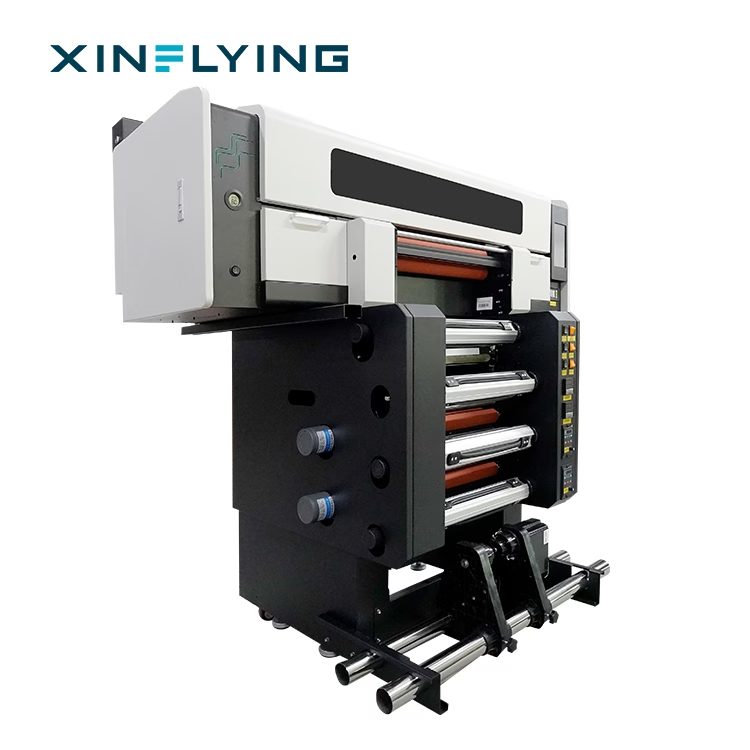
The Xinflying 420ST Gold Stamping 16.5” All-in-one UV DTF Printer illustrates how integrated features can influence an investment decision. The machine uses four Epson i1600-U1 printheads and supports a 16.5-inch printing width. Its listed eight-pass printing speed is 3.5 m²/h.
The system integrates UV printing, gold foil stamping, waste removal, and lamination. It also features a seven-inch touchscreen, one-key operation, a vacuum suction platform, automatic film peeling, printhead anti-collision protection, air-cooled UV lamps, and an intelligent heated base plate.
These capabilities may help businesses produce metallic-effect labels, premium packaging decorations, and customized promotional products through a consolidated workflow. However, the financial benefit depends on whether customers will pay for these applications and whether integration reduces actual production costs.
A prospective buyer should ask the UV DTF printer manufacturer for a current quotation, sample production results, consumable estimates, and maintenance requirements. The listed specifications should be verified against the offered configuration before final calculations.
Compare ROI Across Different Equipment Options
Payback is only one investment metric. Businesses should also evaluate return on investment, calculated as net profit attributable to the investment divided by the total investment cost, multiplied by 100% over a defined period.
For a fair comparison, each machine should be assessed using the same assumptions for monthly sales, selling prices, labor, consumables, and downtime. A higher-priced model may justify its cost if it enables profitable premium orders or reduces manual processing. Additional features, however, should not be assigned financial value without evidence that they improve business results.
The search for Invest Smart: What Determines a Competitive UV DTF Machine Price in 2026 should therefore focus on measurable operating performance, verified specifications, and the supplier’s ability to support production over time.
Make Equipment Investment Decisions With Confidence
A reliable payback estimate connects the initial purchase price with realistic sales forecasts and ongoing expenses. By calculating total ownership costs, contribution margins, and expected recovery time, printing businesses can compare machines using financial evidence rather than price alone.
For companies considering Xinflying’s 420ST, the integrated gold-stamping workflow may be valuable when premium transfers match their target market. Requesting a detailed quotation and testing representative jobs can clarify whether its capabilities support the desired return. A careful evaluation of equipment cost, customer demand, and operational efficiency helps businesses invest strategically and pursue sustainable growth.