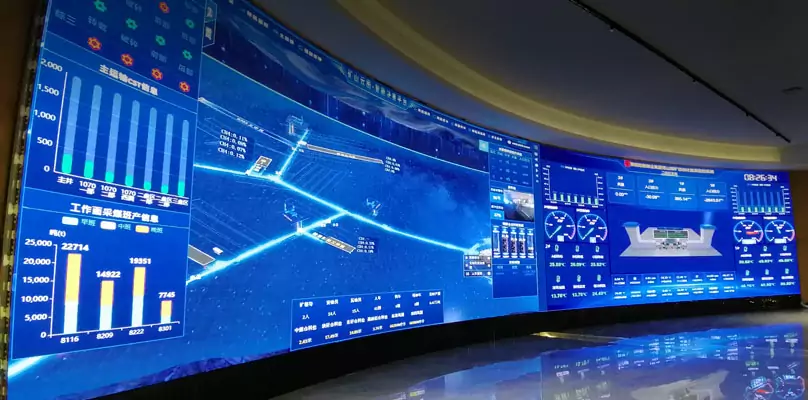
Selecting display technology for a conference room involves more than screen dimensions or purchase price. Viewing distance, content type, installation conditions, and AV compatibility all influence whether the final system fits the room effectively. For organizations assessing an LED display screen, Ledman’s experience in UHD display solutions offers useful context, although the same evaluation principles can be applied across different suppliers and applications.
How to Evaluate Room Dimensions and Seating Layout
Screen selection should begin with the physical characteristics of the meeting space. Room length, width, ceiling height, seating arrangement, and the distance between participants and the display all affect perceived readability. A screen that looks appropriate on a showroom wall may feel too small once installed at the far end of a large conference room.
One practical approach is to calculate the maximum viewing distance first, then work backward toward suitable image dimensions. Presenter slides usually contain text, charts, spreadsheets, and detailed graphics, so legibility should receive more attention than simply filling available wall space.
Seating layout also matters. A room with a wide U-shaped table creates different viewing angles from a classroom-style arrangement. Side seats may require greater horizontal coverage, while deep rooms generally demand sufficient vertical image height. These factors should be documented before suppliers provide final quotations.
How to Match Pixel Pitch With Viewing Distance
Pixel pitch describes the distance between adjacent LED pixels. Smaller pitch values generally support finer image detail, which can be valuable when presentation content contains small fonts or dense diagrams. However, selecting the smallest available pitch is not automatically the most practical decision.
The relationship between pixel pitch and viewing distance should therefore guide specification. Participants sitting close to the display are more likely to notice pixel structure, while viewers positioned several meters away may gain little from an extremely fine pitch. Budget allocation should reflect actual audience distance rather than specification chasing.
Different applications also create different requirements. Executive presentations may prioritize clean text and detailed graphics, whereas video playback can place greater emphasis on motion quality, contrast, and color reproduction. An indoor LED display screen should consequently be evaluated according to the content it will show most frequently.
How to Choose Screen Size and Aspect Ratio
Screen dimensions should complement the room instead of simply maximizing wall coverage. A useful starting point is to estimate the distance from the display to the most distant participant and consider whether typical presentation text can remain readable from that position.
Aspect ratio deserves equal attention. Modern presentation software commonly uses widescreen formats, while video conferencing platforms may introduce multiple participant windows and shared-content layouts. Matching the display proportion with the source format can reduce unnecessary scaling and unused screen areas.
A 16:9 configuration is often suitable for standard business content, but larger installations may require more detailed planning. Multi-source presentations, dashboards, and video feeds can benefit from additional display area when the room supports it.
How to Review AV Integration and Signal Compatibility
Display quality depends partly on the signal chain feeding it. Video processors, conferencing cameras, Microphones, computers, switching equipment, and control systems should be considered together rather than purchased independently.
Compatibility checks should cover input formats, signal resolution, refresh requirements, network connectivity, and control interfaces. Problems often arise when individual components meet their own specifications but do not communicate smoothly as a complete system.
A properly planned LED display screen installation should also leave room for future equipment changes. Conference technology evolves quickly, so accessible connections and flexible signal distribution can reduce unnecessary modification costs later.
How to Examine Installation Conditions and Structural Requirements
Physical installation affects both appearance and long-term operation. Wall structure, mounting depth, cable routes, ventilation, power distribution, and service access should be assessed before equipment arrives. Large displays can require structural preparation that is easy to overlook during early budgeting.
Environmental conditions deserve attention as well. Conference rooms usually offer a relatively controlled setting, but heat generated by electronics can still influence operating conditions. Adequate airflow and appropriate power planning help maintain stable operation during extended meetings.
Ledman’s UHD display solutions illustrate why cabinet and system design should be part of the specification discussion rather than treated as secondary details. The objective is not simply to place pixels on a wall; the installation must work with the surrounding room infrastructure.
How to Plan for Daily Use and Ongoing Maintenance
Operational habits can influence the practical value of the installation. Meeting frequency, average session length, brightness requirements, standby schedules, and content changes should all be considered. A room used several times each day has different operational demands from a boardroom reserved for occasional presentations.
Brightness should correspond to ambient lighting. Excessive brightness may create visual discomfort in darker rooms, while insufficient output can reduce clarity in spaces with strong daylight. Calibration should therefore be based on actual room conditions and typical content.
Maintenance planning is another part of the ownership equation. Service access, spare modules, power components, control hardware, and technical support arrangements can influence downtime and maintenance expenditure. Such considerations become increasingly important as the system grows in size.
Conclusion
Conference room display procurement works best when room geometry, viewing distance, pixel pitch, aspect ratio, AV integration, installation requirements, and operating habits are assessed together. The same framework can be used to compare suppliers without relying solely on headline specifications or purchase price. For organizations considering an indoor LED display screen, careful planning can make the resulting system more appropriate for presentations, collaboration, and video conferencing. Ledman provides a reference point for evaluating UHD display solutions, while the final specification should remain closely tied to the room, content, and intended usage.