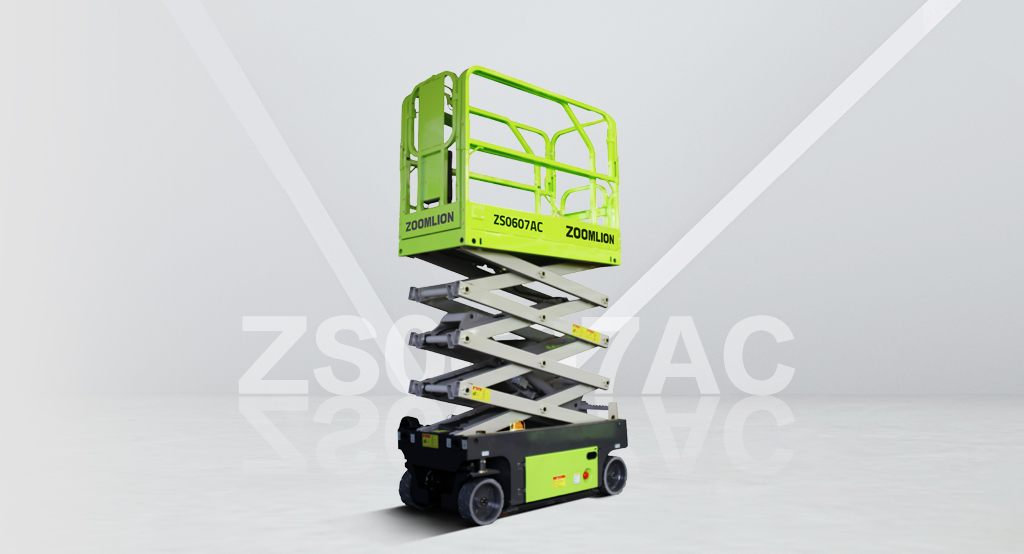
An elevated work platform is not selected effectively by starting with a catalog and choosing the model with the greatest working height. Procurement teams need a requirement that reflects the actual jobsite, task, load, access route, operating environment, and service expectations. A structured set of questions can turn an equipment request into a specification that suppliers can interpret accurately and compare consistently.
- What exactly must the equipment reach?
The first question should define the required working height and horizontal reach, rather than simply asking for a “high” machine. Teams should identify the highest working position, the distance between the machine and the work area, and whether workers need to move around obstacles.
The task geometry also matters. Straight vertical access, outreach requirements, overhead obstructions, and positioning constraints can lead to very different equipment specifications. A requirement based on the actual work area gives suppliers clearer selection criteria and reduces the risk of paying for capabilities the project does not use.
- What load must the machine handle?
Working height means little if the platform cannot safely support the intended occupants, tools, and materials. Procurement should define the expected total platform load and consider whether that load will remain consistent throughout the job or change between tasks.
Teams should also distinguish platform capacity from other lifting requirements. An elevated work platform designed to position personnel is not automatically a material-handling solution. Clear load definitions help prevent unsuitable specifications and give operators a more realistic basis for evaluating machines.
- What does the jobsite require from mobility?
When procurement teams are specifying elevated work platforms, the requirement should describe where the machine will travel, not only where it will work. Ask about entrance widths, floor loading limits, turning space, slopes, ground conditions, indoor or outdoor use, and the distance between staging and the work area.
Mobility can change the equipment class that makes sense. Compact configurations may be more practical for finished indoor floors, while machines designed for demanding ground conditions may be better suited to uneven outdoor surfaces. Procurement teams should also check transport dimensions and machine weight before ordering, because delivery logistics are part of the equipment requirement.
- Which power and operating conditions fit the project?
Power selection should follow the working environment and duty cycle. Buyers can compare electric, diesel, and hybrid configurations according to indoor air-quality requirements, outdoor terrain, charging or fueling access, operating duration, and local project rules.
Noise and emissions may be material procurement criteria on construction, industrial, facility, and urban sites. The specification should state the expected operating pattern and available energy infrastructure. This makes discussions with suppliers more concrete and helps teams compare equipment based on actual use.
- What support is required after delivery?
Procurement should define the support package as part of the requirement, not as an afterthought. Ask about operator documentation, maintenance guidance, inspections, spare-parts availability, response times, warranty coverage, and the supplier’s ability to support the equipment in the deployment region.
This matters because standards and safe-use guidance cover more than machine design. ANSI/SAIA A92.22 addresses application, inspection, training, maintenance, repair, and safe operation of mobile elevating work platforms, while OSHA recommends site hazard assessment, trained operators, manufacturer instructions, maintenance, and pre-start inspections for aerial lifts.
Turning the Questions Into a Procurement Specification
Once the five questions are answered, procurement teams can turn them into a concise equipment brief. It should capture working height, outreach, capacity, dimensions, weight, terrain, power source, duty cycle, mobility constraints, required compliance documents, and after-sales expectations.
This approach also makes supplier quotations easier to compare. Rather than reviewing model names alone, buyers can check whether each proposed machine satisfies the same functional requirements. The result is a more transparent specification that supports technical review, commercial comparison, and project planning.
Where Zoomlion Access Fits the Equipment Discussion
Zoomlion Access offers a broad access-equipment portfolio that includes scissor lifts, articulating boom lifts, telescopic boom lifts, telehandlers, telehandler attachments, spider lifts, vertical mast lifts, vehicle-mounted boom lifts, and forklifts. Their global site also groups equipment by power and machine configuration, which can help procurement teams structure an initial shortlist.
Their company overview states that they provide more than 100 machines across five core MEWP categories, including scissor lifts, telescopic boom lifts, articulating boom lifts, spider lifts, and telehandlers. The published ranges cover different working heights and configurations, giving buyers multiple equipment types to evaluate against the job requirements.
Comparing Equipment With the Right Questions
When reviewing elevated work platforms, procurement teams can use the same five questions across competing quotations: reach, load, mobility, power, and post-delivery support. This keeps the evaluation anchored to operational needs rather than product labels and helps identify where two seemingly similar machines have different practical capabilities.
For buyers considering Zoomlion Access, their product range provides a starting point for matching those requirements to different access-equipment categories. The most useful procurement specification is ultimately one that describes the work clearly enough for suppliers to propose equipment against measurable, site-specific criteria.