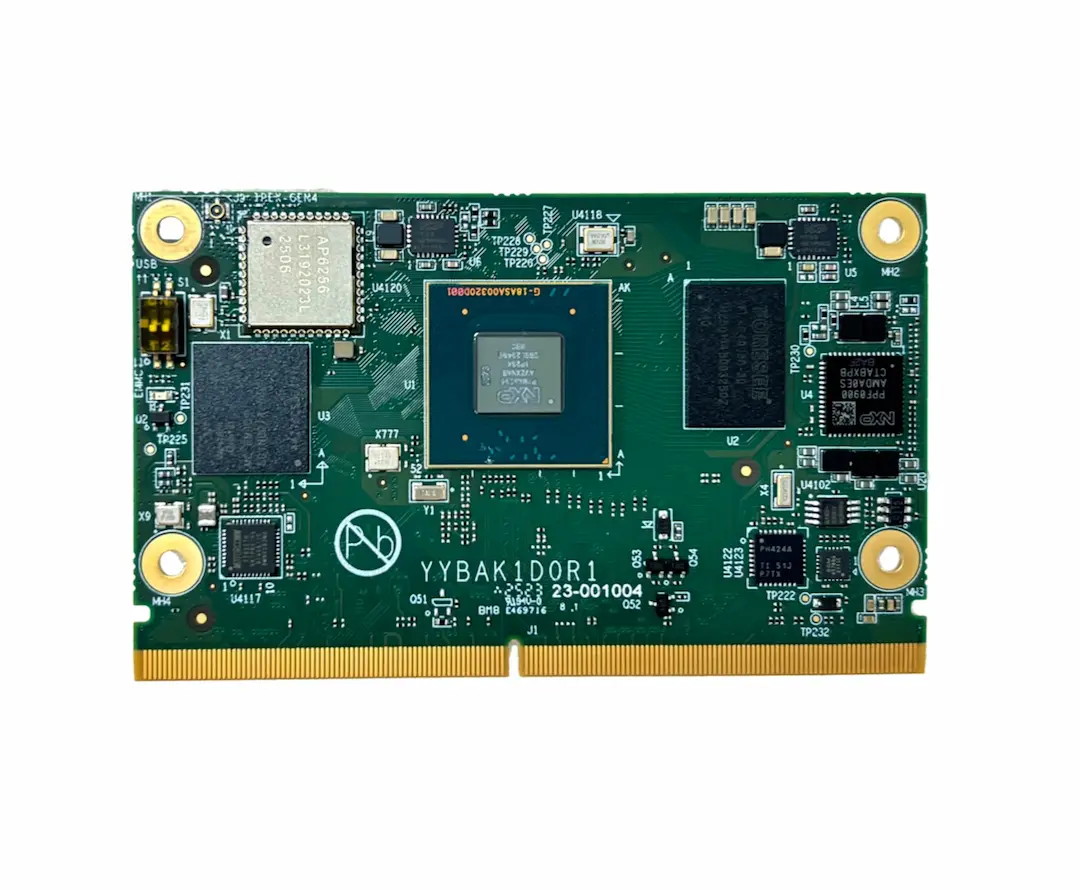
At the prototype bench, the carrier board—not the compute module—often determines whether an embedded design can move cleanly into production. If you are comparing a SMARC SOM with COM Express, start with the interfaces, thermal envelope, and lifecycle assumptions behind the standard.
Founded in 2002, Vantron supplies industrial System-on-Module options built around OSM, SMARC, Qseven, and COM Express. The comparison below helps you match the module family to carrier-board effort, software needs, deployment conditions, and the risk your purchasing team can accept.
The Module Standard Shapes the Whole Product
A System-on-Module is a pluggable compute core. It combines the processor, memory, storage support, and basic system functions on a compact board. Your carrier board then adds application-specific power input, connectors, field interfaces, displays, and expansion. This separation lets one compute design serve several products, but it does not eliminate integration work.
The carrier board is where your real product decisions become physical. A warehouse AGV may need motor-control links, multiple Ethernet paths, and a service connector. A medical cart may prioritize display output, storage, USB, and controlled maintenance access. The module standard influences how cleanly those signals reach the board edge.
For a B2B program, this matters beyond the first prototype. A familiar standard can make second-source evaluation easier, but only if the carrier design uses signals that the replacement module actually supports. Optional interfaces, connector routing, boot behavior, and thermal assumptions still need validation.
What Changes Between SMARC and COM Express?
SMARC and COM Express both define module-to-carrier connections, yet they serve different design priorities. SMARC is commonly associated with compact, power-conscious embedded systems and a broad mix of ARM-based designs. COM Express is often selected when a project needs a mature computer-on-module format with substantial high-speed expansion and a familiar x86 software environment.
That difference affects the enclosure and the carrier layout. A compact SMARC design can suit an autonomous mobile robot, a portable instrument, or a small industrial controller where board area and power budget are constrained. The tradeoff is that your team must check the exact processor, memory architecture, graphics path, and supported I/O for the selected module.
COM Express can be attractive for industrial vision, control cabinets, and systems that depend on established PC-class applications. Its available variants are not interchangeable by assumption. Pin definitions, connector types, optional PCIe or storage signals, and cooling arrangements depend on the selected profile and module. The standard reduces uncertainty; it does not remove the need to read the design guide.
Carrier-Board Effort Is the Practical Dividing Line
Your carrier board should be designed from the module’s signal map, not from a product category label. Begin with the required interfaces, then mark which are native, multiplexed, optional, or unavailable. Separate bring-up functions, such as console access and recovery, from application I/O. This makes prototype debugging less dependent on a single supplier’s software tools.
With a computer-on-module, you can reuse the compute core across related products, but the carrier remains a program asset that you own and validate. Check power sequencing, reset behavior, boot storage, display links, camera inputs, Ethernet timing, USB placement, and connector access. These details decide whether a module swap is a minor redesign or a board respin.
Mechanical planning deserves the same attention. Define the heat path from the processor to the enclosure, reserve clearance for the carrier connector, and check service access before ordering prototypes. A fanless industrial product may be quiet and reliable within its thermal envelope, but a sealed enclosure in direct sun can change that envelope quickly.
Software, Platforms, and Lifecycle Change the Purchase Risk
Hardware standards cannot compensate for a weak software handoff. Ask how the bootloader, board support package, device drivers, kernel updates, graphics stack, and test tools will be maintained. An ARM module may reduce power or simplify a specialized design, but legacy x86 binaries can require a porting cycle. A software decision belongs in the sourcing review.
The referenced System-on-Module line covers OSM, SMARC, Q-seven, and COM Express, and describes long-term availability, evaluation kits, ready-to-use operating systems, and support for Android, Linux, and Windows. It also identifies processor options from NXP, MediaTek, Qualcomm, Rockchip, STMicroelectronics, and Texas Instruments. These details are useful starting points, not substitutes for a project-specific compatibility review.
For a product expected to ship for years, compare the supplier’s lifecycle policy with your own BOM and maintenance plan. Vantron has worked in embedded computing for more than 20 years, employs over 200 research personnel from a variety of fields, and provides FAE technical support. Those numbers do not prove a module fits your design, but they give a buyer concrete questions to test during technical evaluation.
Choose the Standard by Program Risk
Choose SMARC when your product needs a compact module, power-conscious processing, ARM-oriented software, or a flexible path toward embedded control and edge devices. Choose COM Express when your application depends on PC-class software, established x86 deployment practices, or a carrier design that needs the format’s available high-speed expansion options. In both cases, choose the exact profile only after mapping every required signal.
Before you freeze the design, score four items separately: carrier-board reuse, software migration effort, thermal margin, and expected module availability. Then ask whether the module can support your deployment scene, such as an AGV on a warehouse floor, an imaging station, or a factory vision controller. Vantron is one example of a supplier whose category portfolio spans both standards.
The final choice should be recorded as a design rule, not a preference. Document the processor family, operating system, interfaces, cooling method, validation fixtures, and replacement path. Where standard hardware needs adaptation, confirm whether the supplier’s OEM/ODM process supports the specific change, such as OS/software, interfaces and I/O, enclosure/mechanical design, or logo, and ask its FAE team to clarify the applicable engineering requirements.