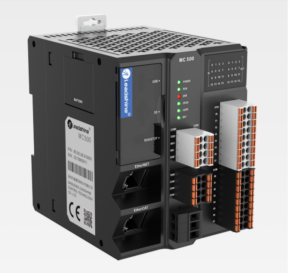
In the automated factory, countless mechanical and electrical components must work together in a precise, reliable, and logical sequence. The device that orchestrates this complex symphony is the Industrial PLC, or Programmable Logic Controller. Functioning as the central brain of a machine or process line, an industrial PLC is a ruggedized computer designed specifically for the harsh industrial environment. Its primary role is to continuously monitor inputs from sensors and switches, execute a user-defined control program, and control outputs to actuators, drives, and indicators. This fundamental “sense-decide-actuate” cycle is what drives automation, making the industrial PLC controller indispensable across all sectors, from simple conveyor systems to complex robotic cells. As a prominent motion control and automation provider, Leadshine extends its expertise into this domain with solutions like its MC500 series, demonstrating how modern industrial PLCs have evolved to integrate advanced motion control, connectivity, and data handling, thereby expanding their traditional role far beyond simple relay replacement.
Core Control and Sequential Logic Execution
The foundational task of any industrial PLC is to execute deterministic logic and sequence control. It replaces hardwired relay panels with flexible, software-based programming (using ladder logic, function block diagrams, or structured text). An industrial PLC controller continuously scans its input modules, reads the status of devices like photoelectric sensors, push buttons, and limit switches, and then processes this data against its stored program. Based on the programmed logic, it updates the states of its output modules, which in turn command contactors, solenoid valves, motor starters, and indicator lights. This provides unparalleled flexibility; a machine’s operational sequence can be changed by modifying the software, not by rewiring a cabinet. Leadshine’s approach to control, embodied in their PLC series, emphasizes this reliability and programmability, ensuring that the core automation logic remains stable and adaptable to process changes.
Integrated Motion Control and Multi-Axis Coordination
Modern manufacturing demands tight integration between logic and motion. Contemporary industrial PLCs have evolved into powerful motion controllers, moving far beyond simple on/off control. A high-performance industrial PLC controller can directly command a network of servo and stepper drives, executing complex coordinated motion. Leadshine’s MC500 series exemplifies this integration. It is an economical bus-type controller that combines robust logic control with significant motion capabilities. It supports control of up to 32 axes over EtherCAT and provides hardware-level functions like 6-axis linear interpolation and 3-axis circular interpolation, crucial for contouring paths in CNC or packaging applications. It also includes specialized motion functions like electronic gearing, E-CAM, and flying shear control. By combining logic and motion in one unified platform, such an industrial PLC from Leadshine simplifies architecture, reduces costs, and ensures perfectly synchronized operation between sequential processes and mechanical movement.
Data Acquisition, Processing, and Communication Hub
Today’s smart factory requires data flow as much as material flow. The industrial PLC serves as a critical data hub. It gathers real-time information from the machine floor—temperatures, pressures, counts, speeds, and diagnostic statuses from drives and I/O. Advanced industrial PLC controller units can process this data locally, perform calculations, and make decisions to optimize the process. Furthermore, they act as a communication gateway. Leadshine’s MC500, for instance, is equipped with multiple industrial network protocols. Beyond EtherCAT for motion, it supports EtherNet/IP and OPC UA for seamless vertical integration with HMIs, SCADA systems, and Manufacturing Execution Systems (MES). It also features CANopen for distributed I/O control and standard communication ports for devices like barcode readers. This connectivity transforms the industrial PLC from an isolated controller into a node in the Industrial Internet of Things (IIoT), enabling remote monitoring, predictive maintenance, and production analytics.
Safety and Reliability Management
In an industrial setting, control must be both intelligent and safe. While dedicated safety PLCs exist, many standard industrial PLCs incorporate or interface with safety functions to monitor emergency stops, safety gates, and light curtains. They manage routine safety interlocks within their control programs. More importantly, the inherent reliability of an industrial PLC controller is paramount. Designed for 24/7 operation with wide temperature ranges, immunity to electrical noise, and robust construction, they provide a stable control platform. Leadshine emphasizes the stability and reliability of its control solutions, which are critical in the high-value industries it serves, such as photovoltaic and semiconductor manufacturing. Features like comprehensive diagnostics and built-in protections (over-temperature, over-voltage) in the hardware further enhance system uptime and protect valuable assets.
Modularity and Scalable System Architecture
Industrial applications vary immensely in size and complexity. The modular design of most industrial PLC systems allows engineers to tailor the controller precisely to the application’s needs. A system can start with a compact central processing unit (CPU) and expand by adding modules for additional digital/analog I/O points, specialized communication ports, or motion control cards. Leadshine’s offering supports this philosophy. Their MC500 series can locally expand with up to 32 I/O modules, supporting a total of 32,767 I/O points, and can manage 32 CANopen nodes for distributed control. This scalability means a machine builder can use a common, familiar platform from small to very large machines, reducing training costs and spare part variety. The ability to scale the industrial PLC controller seamlessly makes it a future-proof investment.
In essence, the industrial PLC is the indispensable workhorse and intelligent coordinator of modern automation. It performs the critical triad of functions: executing reliable logic sequences, orchestrating precise motion, and facilitating data exchange across the enterprise. As demonstrated by Leadshine’s MC500 series, the contemporary industrial PLC controller is no longer a mere logic solver but a comprehensive automation platform that balances motion control, rich functionality, and intelligent connectivity. By fulfilling these multifaceted roles, industrial PLCs empower manufacturers to build equipment that is not only automated but also efficient, connected, and adaptable, forming the very foundation upon which smart, responsive, and productive industrial operations are built.